Robotic laser welding: advantages over traditional methods
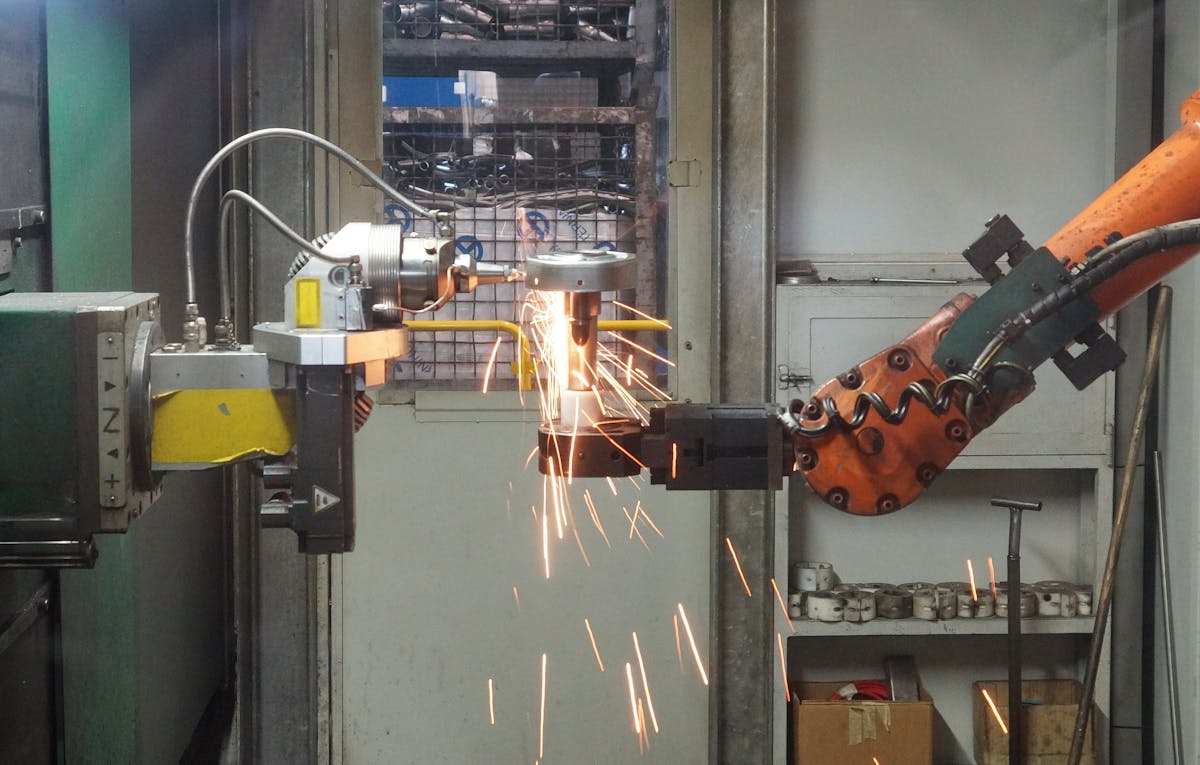
The evolution of industrial welding
Welding is one of the fundamental processes in metal fabrication. For decades, manual and semi-automatic processes (TIG/GTAW, MIG/GMAW, stick/SMAW) have been the industry standard. They are versatile, well-understood processes with a wide base of certified welders.
However, growing demand for quality, repeatability, and productivity has driven the development of robotic laser welding. At Cortalia, we have incorporated this technology to complement our conventional certified welding processes.
How laser welding works
Laser welding uses a concentrated high-energy light beam to melt and join materials. The power density at the focal point is extremely high, allowing narrow, deep weld seams with minimal heat input to the overall part.
When mounted on a robotic arm, the process gains millimetric repeatability. The robot reproduces exactly the same trajectory, speed, and parameters on each part, eliminating the variability inherent in manual work.
Advantages over conventional welding
Minimal thermal distortion: the heat-affected zone (HAZ) is up to 10 times smaller than in TIG or MIG welding. This means less deformation, less residual stress, and less need for straightening or post-weld heat treatment.
Higher speed: laser welding can be 3 to 10 times faster than conventional processes, depending on thickness and joint configuration.
Perfect repeatability: the robot ensures every bead is identical to the previous one. In production runs, this translates to zero rejects from operator variability.
Narrow, aesthetic beads: laser produces thin, uniform weld beads that in many cases require no cleanup, reducing finishing operations.
Access to complex geometries: the robotic arm can access hard-to-reach areas with precision impossible to achieve manually.
When is conventional welding still better?
Robotic laser welding does not fully replace conventional processes. TIG welding remains irreplaceable for repairs, one-off parts, thick sections, and situations requiring the welder's adaptability.
MIG and SMAW processes are better suited for field welding, large-volume fill, and situations where joint preparation cannot be as precise as laser requires.
At Cortalia, we maintain a full team of certified welders under ASME and UNE standards, working with GTAW, SMAW, and GMAW processes. The combination of robotic laser welding and certified manual welding allows us to tackle any project.
Industrial applications
Robotic laser welding excels in: aerospace components where minimal distortion is critical, automotive series parts, nuclear sector components requiring repeatability and full documentation, heat exchanger fabrication with high-tightness seams, and production of precision parts where surface finish matters.
At Cortalia, laser welding integrates with our laser and waterjet cutting, CNC machining, and boilermaking processes, offering a complete manufacturing workflow under ISO 9100 and UNE 73401 certifications.
Have an industrial project?
Our engineering team provides free consultations. We analyze your project and propose the most efficient solution in terms of quality, lead time, and cost.