Robotic Welding Advantages: When to Choose Automated Over Manual
Why Robotic Welding Is Reshaping Industrial Production
In many fabrication shops, welding remains a bottleneck: skilled manual welders are scarce, and their output varies from shift to shift. Robotic welding changes that equation by delivering repeatable, high-quality welds on a predictable schedule. For industrial buyers evaluating subcontractors, this capability is no longer a luxury—it is a practical way to secure capacity and consistency.
The core advantage is repeatability. A robotic cell executes the same weld path, torch angle, and parameters every cycle. Once a program is validated, the result is essentially identical on the first part and the ten-thousandth. That uniformity reduces rework, simplifies inspection, and gives you confidence in the structural integrity of every assembly.
Robotic welding also addresses the labor challenge. While manual welding depends on the availability and skill of certified welders, a robot can run lights-out or with minimal operator oversight. This does not eliminate the need for human expertise—programming and supervision remain critical—but it shifts the bottleneck from manual dexterity to process control.
Where Robotic Welding Excels: Repetition and Volume
Robotic welding shines when parts are repetitive or produced in significant quantities. If your product family shares common joint configurations, a robot can be programmed once and then run those welds for months with minimal variation. This is ideal for brackets, frames, enclosures, and other structural components that appear across multiple assemblies.
High-volume runs also benefit from speed. A robot moves from weld to weld without fatigue, and its travel speed is often higher than a manual welder can sustain over a full shift. While the exact cycle time depends on part geometry and weld size, a robotic cell typically completes a given weld sequence faster than manual methods once fixturing and programming are optimized.
Even for medium-volume work, robotic welding can pay off if the parts are complex enough to require multiple passes or precise torch angles. The robot’s repeatability ensures that every pass lands exactly where intended, reducing the risk of undercut, overlap, or missed fusion that can occur with manual fatigue.
Consistency and Quality Control
Manual welding quality varies with operator skill, fatigue, and even mood. Robotic welding removes that variability. The weld parameters—voltage, current, travel speed, wire feed—are locked in the program. The result is a consistent bead profile, penetration, and appearance across the entire batch.
This consistency simplifies quality assurance. Instead of inspecting every weld for human error, you can rely on statistical process control and periodic destructive testing of sample parts. The robot’s logs provide a traceable record of every weld, which is valuable for industries with strict documentation requirements.
Robotic cells also integrate well with vision systems and seam tracking. These technologies allow the robot to adjust for minor part variations, ensuring the weld stays on the joint even if the fixturing is not perfect. This reduces the need for expensive, high-precision fixtures and makes the process more robust.
When Manual Welding Still Makes Sense
Robotic welding is not a universal solution. For one-off prototypes, highly custom fabrications, or very low volumes, the programming and fixturing overhead may outweigh the benefits. A skilled manual welder can often start immediately on a unique part, while a robot requires time to set up and validate the program.
Manual welding also remains preferable for parts with poor fit-up or highly variable joint gaps. A human welder can adapt in real time, adjusting technique to bridge gaps or compensate for misalignment. Robots, even with seam tracking, struggle with extreme variability and may require additional pre-machining or fixturing to achieve acceptable results.
Additionally, some weld positions and joint types are difficult to automate. Overhead welding, tight corners, or welds in confined spaces may be more practical for a manual welder with a flexible torch. The decision should be based on part geometry, tolerance, and expected volume—not on a blanket assumption that automation is always better.
Integrating Robotic Welding with Cutting and Machining
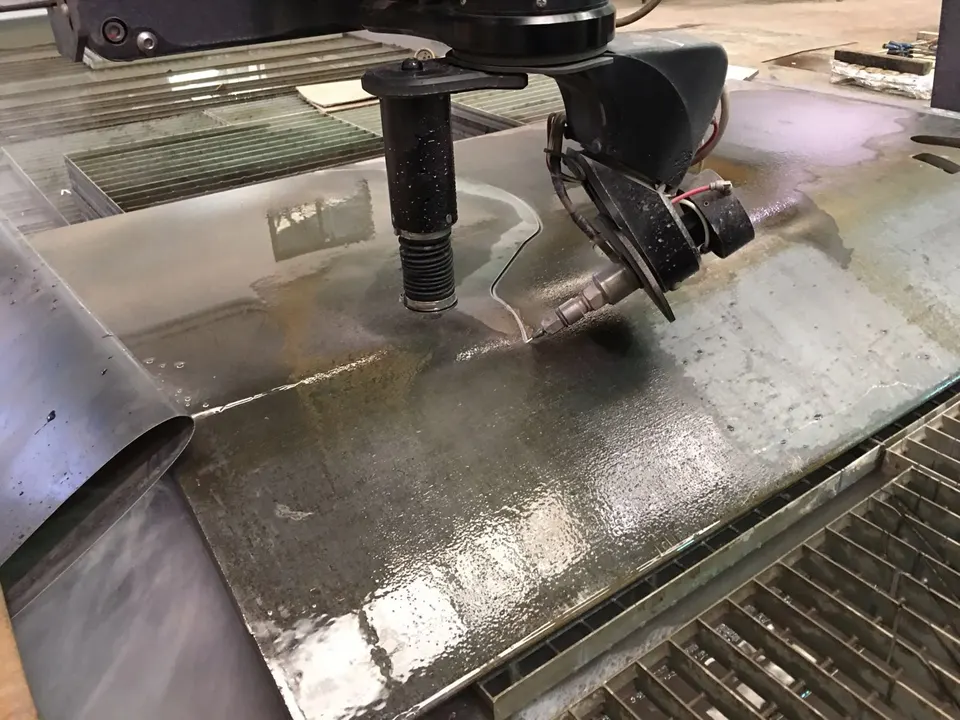
The true power of robotic welding emerges when it is part of a broader automated workflow. At Cortalia, we combine robotic welding with waterjet cutting, laser cutting, and CNC machining. This integration ensures that parts arrive at the welding cell with consistent geometry and edge preparation, which is critical for robotic success.
For example, laser-cut parts have tight tolerances and clean edges, reducing the need for weld prep and improving fit-up. Machined features can serve as locating datums for robotic fixturing, ensuring the robot starts each weld in the right place. This upstream precision directly translates into better weld quality and fewer rejects.
By handling cutting, machining, and welding under one roof, we eliminate the coordination delays and quality gaps that occur when multiple suppliers are involved. The result is a smoother production flow, shorter lead times, and a single point of accountability for the final welded assembly.
Making the Business Case for Robotic Welding
When evaluating robotic welding, consider the total cost of ownership, not just the hourly rate. Robotic cells require upfront investment in programming, fixturing, and sometimes dedicated floor space. However, for the right part mix, the savings in labor, reduced rework, and increased throughput can deliver a strong return.
A useful rule of thumb: if you are welding more than a few hundred identical or similar parts per year, robotic welding is likely worth investigating. The exact break-even point depends on part complexity, weld length, and current manual welding costs, but the trend is clear—automation becomes more attractive as volume increases.
Quality consistency also has financial value. Fewer weld defects mean less scrap, less rework, and fewer field failures. For safety-critical components, the traceability and repeatability of robotic welding can reduce liability and improve your reputation with end customers.
Partner with Cortalia for Your Robotic Welding Needs
Choosing between robotic and manual welding is not a simple either/or. The best solution often combines both: robots for repetitive, high-volume welds and skilled manual welders for complex or low-volume work. At Cortalia, we offer both capabilities, along with in-house cutting and machining, to deliver welded assemblies that meet your specifications efficiently.
If you are unsure whether your parts are suitable for robotic welding, send us your drawings. Our engineering team will evaluate the geometry, volumes, and quality requirements, and recommend the most cost-effective welding approach. With our integrated manufacturing services, you get a single partner for the entire process—from raw material to finished welded assembly.
Contact Cortalia today to discuss your next welding project. We will help you decide when robotic welding is the right choice and provide a competitive quote based on your specific needs.
Have an industrial project?
Our engineering team provides free consultations. We analyze your project and propose the most efficient solution in terms of quality, lead time, and cost.